

Nonprofit organizations play a vital role in our communities, but they also face a unique set of financial, operational, and compliance challenges. From managing restricted contributions and grant funding to maintaining adequate internal controls and meeting donor and regulatory requirements, nonprofit leadership must balance mission-focused objectives with sound financial stewardship.
At abip P.C., we recognize that a nonprofit audit is more than simply verifying numbers; it is an opportunity to understand the organization's operations, identify areas of risk, and provide meaningful insight to management and those charged with governance. This article highlights key issues facing nonprofit organizations in 2026 and the areas leaders and auditors should focus on to support reliable, transparent financial reporting.
1. Liquidity and Financial Sustainability
Liquidity remains a leading concern. Nonprofit Finance Fund's 2025 survey reported that 52% of respondents had three months or less of cash on hand, 18% had one month or less, and 36% ended 2024 with an operating deficit. Revenue alone does not ensure liquidity when funding is restricted, reimbursable, delayed, or concentrated among a few sources.
Key focus: Monitor unrestricted cash, receivable aging, funding concentrations, covenant compliance, and realistic cash-flow forecasts. Persistent losses or uncertain funding may also require a more robust going-concern assessment.
2. Funding Uncertainty and Scenario Planning
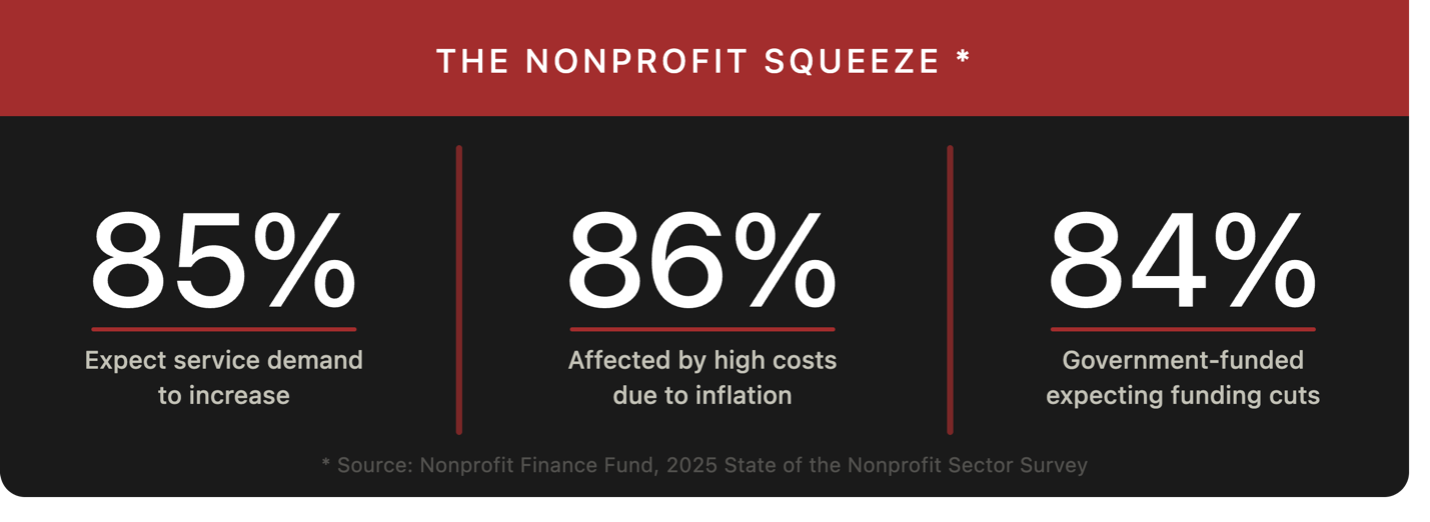
More than 70% of surveyed organizations received government funding, and 84% of those respondents’ expected cuts. Funding delays or reductions can affect direct recipients, pass-through entities, foundations, and the communities they serve. A single annual budget may not be enough in this environment.
Key focus: Model base, downside, and severe funding scenarios; identify fixed versus adjustable costs; and evaluate the full administrative and compliance cost of new funding. For federal awards, continue emphasizing SEFA accuracy, allowable costs, procurement, and subrecipient monitoring.
3. Staffing Capacity and the Financial Close
Workforce constraints can quickly become accounting and internal-control issues. Only 41% of survey respondents reported being able to pay all full-time staff a living wage. Lean finance teams may depend heavily on one person to record transactions, reconcile accounts, administer grants, and prepare audit support, which can create delays and loss of institutional knowledge when turnover occurs.
Key focus: Crosstrain staff, document recurring procedures, formalize the close calendar, and identify compensating review controls where ideal segregation of duties is not practical. Repeated audit adjustments and late reconciliations may signal that processes have not kept pace with growth or complexity.
4. Technology, Cybersecurity, and Fraud Risk
Electronic payments, cloud systems, online fundraising platforms, and remote approvals improve efficiency but also change the risk profile. Business email compromise, fraudulent vendor-payment changes, compromised credentials, and unauthorized electronic disbursements can create losses quickly, particularly for organizations with small finance teams.
Key focus: Use multifactor authentication, independently verify vendor banking changes, require dual approval for significant payments, restrict administrator access, and periodically review user permissions. Continue foundational accounting controls over reconciliations, journal entries, credit cards, restricted contributions, and payable cutoff.
5. More Meaningful Information for Boards and Stakeholders
Boards, donors, grantors, and lenders increasingly expect timely information about liquidity, program performance, funding concentrations, and organizational risk. With 85% of respondents expecting increased demand and 86% reporting effects from inflation, revenue growth by itself may not indicate stronger financial health.
Key focus: Provide a focused dashboard that may include unrestricted liquidity, months of cash on hand, budget-to-actual results, grant-reimbursement aging, fundraising trends, vacancies, and program measures. Audit committees should also understand significant estimates, audit adjustments, control observations, fraud risks, and prior-year recommendations.
Looking Ahead
Nonprofits continue to be asked to do more while operating with limited liquidity, uncertain funding, rising costs, and constrained administrative capacity. The strongest response is proactive: evaluate liquidity before it becomes a crisis, model funding scenarios before support is lost, strengthen controls before fraud occurs, document processes before key employees leave, and give boards meaningful information before difficult decisions are required.
As nonprofit organizations navigate an increasingly uncertain economic environment, abip P.C. serves as more than an audit provider. We help nonprofit leaders respond to these challenges through advisory and client accounting services, strategic financial planning, tax guidance, and consulting support, helping organizations better understand their financial position, evaluate risks and opportunities, strengthen internal processes, and make informed decisions. abip's broader approach is centered on understanding each client's goals and providing solutions that address obstacles beyond compliance requirements. By combining nonprofit industry knowledge with practical financial and advisory expertise, abip P.C. helps nonprofit organizations remain financially prepared, adapt to changing economic conditions, and preserve their ability to fulfill their missions and serve their communities for the long term.
Is Your Nonprofit Prepared for What Is Ahead?
The challenges facing nonprofit organizations in 2026 are real, but they are manageable with the right guidance and the right team in your corner.
Whether you are concerned about liquidity, navigating funding uncertainty, strengthening internal controls, or simply want a clearer picture of your organization's financial health, abip P.C. is here to help.
Do not wait for your next audit to surface issues that could be addressed today. Contact our nonprofit team to schedule a conversation about where your organization stands and what steps you can take now to protect your mission for the long term.
Contact Joseph Murphy, CPA Manager at abip P.C. today at 713.350.2456 or visit abip.com to connect with our advisory team.
Source: *Nonprofit Finance Fund, 2025 State of the Nonprofit Sector Survey. https://nff.org/state-of-the-nonprofit-sector-survey/2025-state-of-the-survey-nonprofit-sector-survey/